

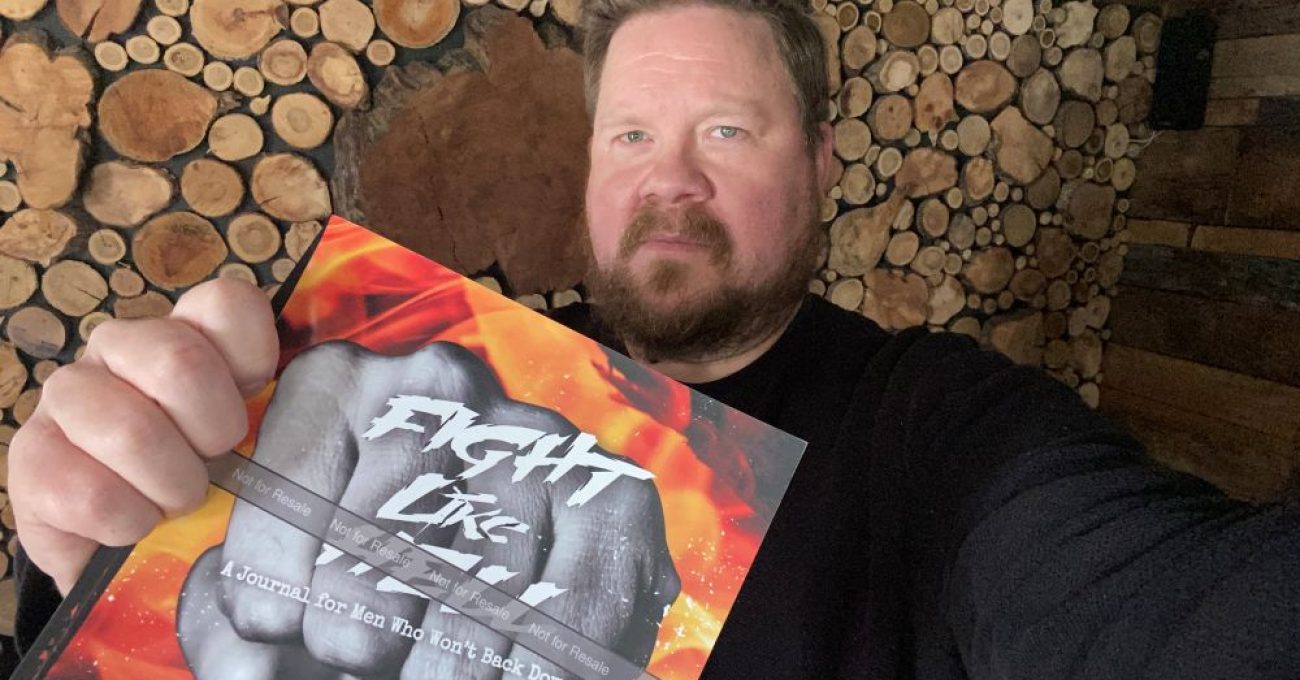

This journal came out of a season where I needed to stop lying to myself.
Not out loud. Quietly. Internally. The kind of lying where you stay busy, stay productive, stay useful—so you don’t have to slow down and actually look at what’s going on inside you.
Writing interrupted that.
Putting words on paper forced me to pay attention. To frustration I kept glossing over. To patterns I already knew were there but didn’t want to deal with yet. To questions that didn’t have clean answers.
I wasn’t writing to create something for other people. I was writing to stay engaged with my own life.
Over time, that practice took shape. A rhythm. Short reflections. Questions that didn’t let me hide. Space to tell the truth without needing to impress anyone.
Eventually, those pages became Fight Like Hell.
Doing the Work Alone… and Then Not Alone
For a long time, this work was just mine.
Then I took a small group of guys through it for a month.
We didn’t add anything fancy. No extra curriculum. No motivational talks. All we did was go through the journal together.
Each day, we worked through the prompts on our own. We shared—honestly—what we were seeing and working on in a group chat. Once a week, we got on a call and talked it through.
That was it.
And it was transformational.
Not because anyone had the right answers. But because men showed up. They named things they’d never said out loud before. They stayed with uncomfortable truths instead of running from them. They listened to each other without fixing or posturing.
I watched clarity emerge. Ownership deepen. Walls soften.
It confirmed something I already suspected: the journal works best when it’s actually used—especially when men stop pretending they’re fine.
We’ll be doing it again.
When Other Men Put Words to It
Around the same time, I started getting messages and reviews that stopped me cold.
One man wrote:
“This was the absolute best journal for a man suffering from a devastating setback and aiming to rebuild himself.”
Another said:
“If you are ready to dig deep, this book will make you do it.”
Then there were words I didn’t know what to do with at first:
“This book saved my life.”
“This book is no joke.”
I sat with those.
I still do.
I don’t believe a book saves anyone. I do believe that creating space for honesty—real, unfiltered honesty—can change the direction of a life.
Why the Journal Is the Way It Is
The journal is simple on purpose. Short sections. Direct questions. Enough structure to keep you showing up, enough space to let the truth surface.
The audio—where I read the reflections out loud—came from my own experience. Some days, I needed to hear the words while my pen moved. It helped me stay present when my mind wanted to check out.
Nothing in this journal was added to make it more impressive. It was added because it helped me stay honest.
Why I’m Still Grateful for This Work
Fight Like Hell exists because I needed a place to stop drifting.
The fact that other men have used it while rebuilding their lives, walking through hard seasons, or finally dealing with things they’d been carrying for years—that humbles me.
I don’t see this journal as a solution.
I see it as a place to begin paying attention.
If you want to read more about the heart behind it, that lives here.
If you want to hear more of the story out loud, these conversations give context:

And if it feels like something you’d sit with—alone, or alongside other men—you can find Fight Like Hell here.
No promises. No polish.
Just a place to tell the truth—and keep showing up.